
Get the weekly community digest




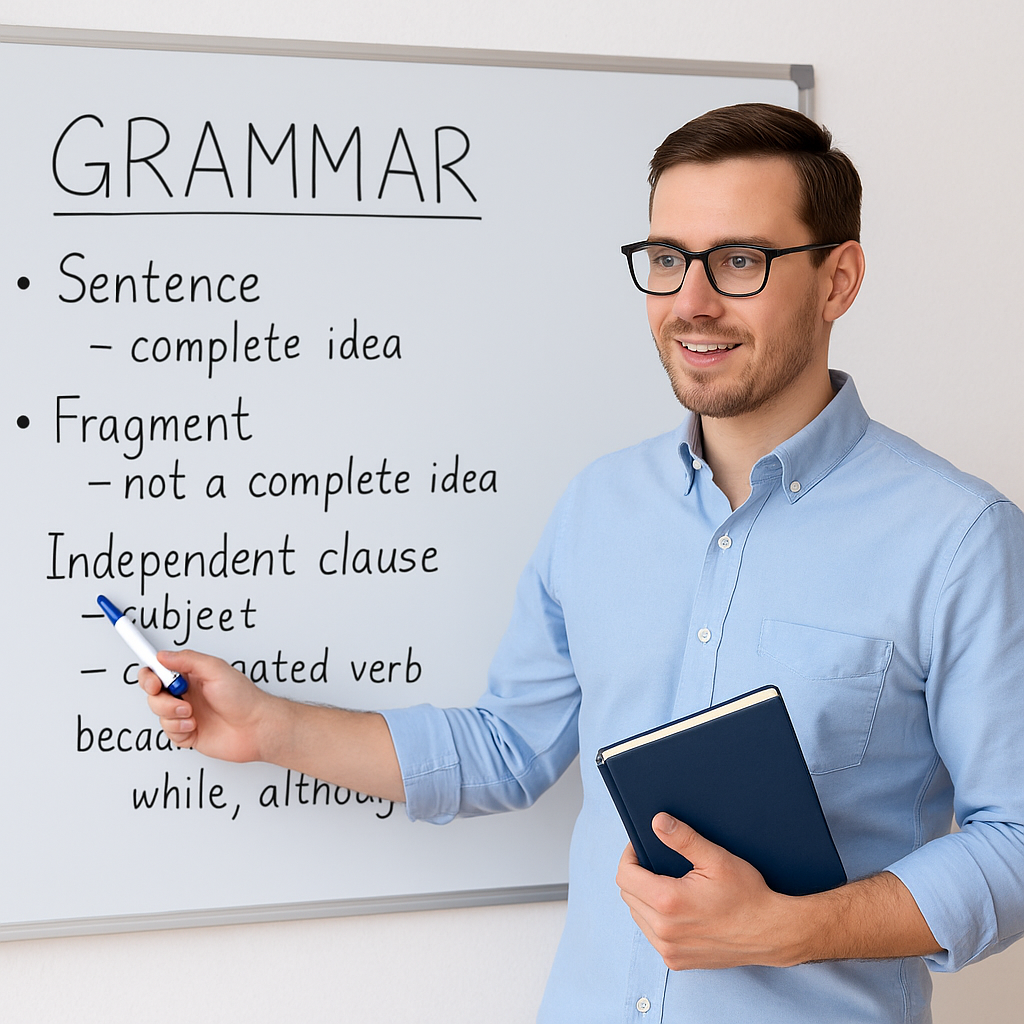
Here is the truth about grammar on the new digital SAT: English grammar is huge, but the test is not. The College Board pulls from a small, repeatable set of ideas. If you master the five most frequent concepts below, you can answer well over half of the Reading and Writing grammar questions with confidence.
The rule: Every complete sentence needs at least one independent clause. That clause must have a subject, a fully conjugated verb, and it cannot be introduced by a subordinating word such as because, while, although or a relative pronoun such as which, that.
Ear test: Fragments sound unfinished. If it feels like the sentence is waiting for something, it probably is.
Example pattern:
“Some historians ___ that tulip mania was the first asset bubble, which occurs when...”
The which clause is not independent.
Before which, you still need a full clause.
Subject is historians. Supply a conjugated verb: claim.
Correct: “Some historians claim that…”
Quick check: Find the subject. Make sure the verb is a real tense form, not just an -ing or a to-verb.
When you have two independent clauses, you must join them correctly. The three clean options:
Period
Semicolon
Comma + coordinating conjunction (FANBOYS: for, and, nor, but, or, yet, so)
Wrong: Two clauses with no punctuation (run-on).
Wrong: Two clauses with only a comma (comma splice).
Fix it:
“The theory explains the die-off, it left other questions.” →
“The theory explains the die-off, but it left other questions.”
or “The theory explains the die-off; it left other questions.”
or “The theory explains the die-off. It left other questions.”
Tip: If you spot a full sentence on each side, reach for period, semicolon, or comma + FANBOYS.
The rule: Singular subject takes a singular verb. Plural subject takes a plural verb.
Traps the test likes:
Long introductory phrases.
Subjects disguised as phrases that look plural but function singular.
Example:
“Landing on one of the good spaces ___ a player to skip ahead.”
Subject is Landing on one of the good spaces. That idea is singular.
Correct verb: allows.
Another:
“The award-winning book is Harris’s first novel, but her writing ___ honored before.”
Subject after the comma is writing. That is singular.
Correct verb: has been.
Practical move: Find the true subject before you touch the verb. Ignore prepositional phrases and details in the middle.
The rule: A pronoun must match its noun in number and must stay consistent with other pronouns in the sentence or paragraph.
Examples:
“Cashiers asked customers whether ___ wanted a bag.”
Referent is customers. Plural. Use they.
“___ findings were based on the famous x-ray image.”
Referent is Watson and Crick. Plural. Use their.
Note on possessives: its, his, her, their do not take apostrophes.
Tip: Point to the noun the pronoun replaces. Say it out loud. If it does not match in number, fix it.
A modifier gives extra info and must sit next to what it describes. On the SAT you often see a leading phrase, then a comma, then the target.
Pattern:
“Upon recovering two years later, ___ resumed the reign.”
Who recovered? Henry did. The word following the comma must be Henry.
Correct: “Upon recovering two years later, Henry resumed his reign.”
Another:
“Despite being cheap, versatile, and easy to produce, ___ have two associated problems.”
What is cheap, versatile, easy to produce? Commercial plastics.
Correct: “Commercial plastics have two associated problems.”
Fix it fast: After the comma, start with the noun that the opening phrase describes.
Common subordinating words
because, although, while, if, when, since, after, before, unless, whereas
Relative pronouns
which, that, who, whom, whose
FANBOYS
for, and, nor, but, or, yet, so
Try these. Answers are below.
“Many researchers ___ the new data supports a different conclusion, which may reshape the field.”
A. suggest
B. suggesting
C. to suggest
D. have suggested to
“The telescope revealed key details, ___ it also raised new questions.”
A. however,
B. but
C. and;
D. therefore
“A series of unexpected delays ___ the launch by two weeks.”
A. have pushed
B. has pushed
C. were pushing
D. push
“Before boarding, passengers must show ___ tickets at the gate.”
A. his or her
B. its
C. their
D. one’s
“Running through the forest at dusk, ___ were hard to spot.”
A. the hikers
B. the trail markers
C. the group of friends
D. they
Answer key with notes
A. suggest
Subject is “researchers.” Plural. Use plural verb suggest. The which clause is extra.
B. but
Two independent clauses. Comma + coordinating conjunction works. “However” needs stronger punctuation or a semicolon.
B. has pushed
True subject is series. That is singular. Use has.
C. their
Passengers is plural. Match with plural pronoun.
B. the trail markers
Who or what was hard to spot at dusk? Trail markers. Place the noun that the opening modifier describes immediately after the comma.
Read the sentence with the blank in context.
Label the pieces. Find subjects, verbs, clause types, and any joiners.
Check the big five in this order: fragment, run-on or comma splice, subject-verb agreement, pronoun agreement, modifier placement.
Use the ear test, then prove it. If it sounds off, confirm by rules.
Eliminate wrong forms, then pick the cleanest grammar.
You don’t need to master all of English grammar to earn a top SAT score — you just need to know the patterns the test loves. Focus on these five grammar concepts, practice them often, and make consistency your secret weapon.
To do that, use Preppinbee’s Question Bank and Predicted Questions, which mirror real SAT question styles and difficulty. Alongside Khan Academy SAT Prep, Preppinbee is one of the best College Board supplementary platforms for sat preparation.
It’s free to sign up, and you can start practicing right away — sign up here: https://sat.preppinbee.com/signup
Keep practicing daily, review your mistakes carefully, and you’ll see your grammar accuracy — and your overall SAT score — climb fast.