Get the weekly community digest




There is no single "required" SAT or ACT score that works for every college. Each school publishes the score range its admitted students actually achieved, and those ranges vary enormously — the most competitive universities cluster far higher than mid-tier and state schools. The number you need depends entirely on which schools are on your list, which is why looking up each school's published data is the essential first step in setting a target score.
Scores carry weight again at many universities after the test-optional years, and they continue to affect merit scholarship eligibility even where admission itself is test-optional. Several highly selective institutions have reinstated SAT or ACT requirements for the 2025–26 admissions cycle, and the trend suggests that submitting a strong score is increasingly valuable — whether a school formally requires it or not. Even at test-optional schools, students who submit scores above the school's median tend to gain an admissions edge and qualify for merit aid that non-submitters miss.
The figure worth paying attention to is not a single cutoff number but the middle 50% range — the band between the 25th and 75th percentile scores of a college's admitted class. This range tells you where the bulk of successful applicants landed, and it is far more useful than an average or a minimum. The next section explains exactly how to read it and how to use it to set a realistic, school-specific target.
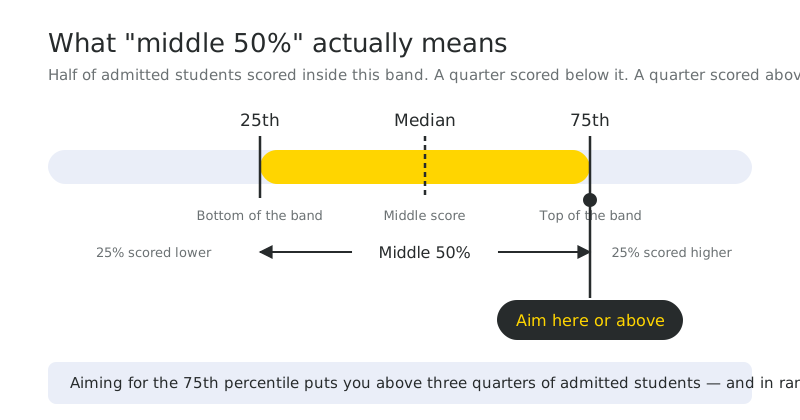
The middle 50% spans the 25th to 75th percentile of admitted students, meaning half the class scored within this band. A quarter of admitted students scored below the range and still got in, and a quarter scored above. It is a description of who was actually admitted, not a hard threshold — and it gives you a much better picture than a single average or an artificially low minimum. When a school reports a middle 50% SAT range of 1350–1510, for instance, that tells you the competitive zone and helps you decide how much improvement you need from your current score.
Many colleges superscore the SAT, meaning they combine your highest section scores across multiple test dates into a single composite. If you scored higher on Reading & Writing in March and higher on Math in June, the school uses those two bests together. This changes the math on whether a retake is worth it: even a modest section improvement on a second sitting can lift your composite meaningfully, since only the higher section replaces the lower one. Check whether each school on your list superscores before deciding how many times to sit for the test.
In 2026, colleges fall into three broad testing categories. Test-required schools expect every applicant to submit an SAT or ACT score; test-recommended schools do not mandate scores but signal that submitting them helps; and test-optional schools leave the decision to the student. In practice, test-optional does not always mean test-blind — many admissions offices still consider scores when submitted, and internal data at several institutions shows that submitters are admitted at higher rates. If your score is at or above a school's median, submitting it is almost always advantageous.
Merit scholarships frequently use SAT or ACT score thresholds, even at schools that are test-optional for admission. A score above a certain cutoff can unlock automatic awards worth thousands of dollars per year, and many families discover that improving a score by even 50–100 points crosses a scholarship threshold that pays for itself many times over. Because scholarship criteria are published separately from admissions requirements, check both the admissions policy and the financial aid page for each school on your list.
Start by taking a baseline diagnostic — a full-length practice test in the real Digital SAT format. Compare your result against the 75th percentile of your target schools to measure the gap. A gap of 100 points or fewer is typically closable with focused practice over a few weeks; a larger gap may call for a longer study plan or a broader school list. The goal is not a perfect score but a score that lands you solidly inside the competitive range for the schools you actually want to attend.