Get the weekly community digest




Preppinbee tutors are online, specialise in the Digital SAT and ACT, and have full public profiles where they describe their teaching approach in their own words. You are not reading a stock bio written by a marketing team — you are reading what the tutor actually does, how they teach, and what they focus on.
Browse profiles, read each tutor’s approach, then book a free one-to-one session or join one of their live classes. Many tutors run both — structured recurring classes for small groups, and individual sessions for targeted work — so you can choose the format that fits.
Everything in the Preppinbee community is free, including the tutoring: practice tests, the question bank, AI study plans, the dashboard, the community and every session with a tutor. No packages, no commitment.
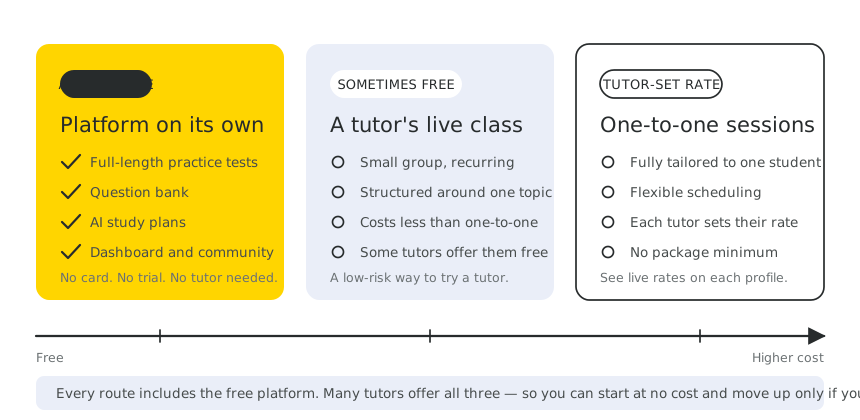
SAT and ACT tutoring rates vary widely depending on the tutor’s experience and format. Entry-level and graduate-student tutors commonly charge $45 to $80 per hour; experienced independent tutors typically charge $80 to $200 per hour; and section-specialist coaches at structured programs charge $150 to $500 or more per hour (source: Ivy Strides, 2026). These are industry figures, not Preppinbee rates — they represent what parents commonly encounter when shopping for tutoring.
On Preppinbee it costs nothing. Tutors in the community teach one-to-one sessions, live classes and webinars free, and the platform around them is free too.
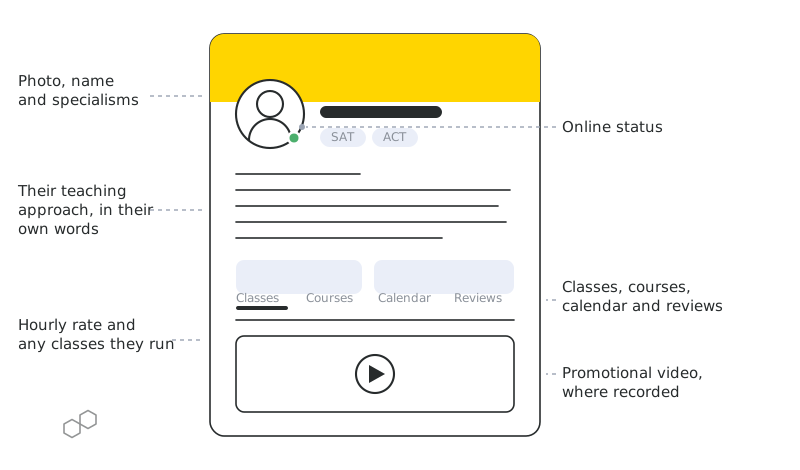
Every tutor profile on Preppinbee includes:
You can see who the tutor is, what exams they cover, and which sections they specialise in — Math strategy, Reading & Writing, grammar, ACT pacing, or a combination.
Real methodology, not stock copy. A tutor who teaches a repeatable system for approaching quadratic problems says so. A tutor who focuses on pacing drills describes that. You know what you are getting before you book.
If a tutor runs a recurring class or webinar, you can see the schedule and topic and join from their profile.
Tabs on the profile show the tutor’s class listings, any courses they have published, their availability calendar, and reviews from other students.
Where a tutor has recorded one, you can watch a short video to get a sense of how they teach before reaching out.
Fully tailored to one student. The tutor can diagnose specific weaknesses, adjust the pace in real time, and focus on exactly what that student needs. Scheduling is flexible and agreed between tutor and student. It is the most focused format because the tutor’s full attention is on one student.
Structured, recurring, and taught to a small group on a set schedule. Classes follow a planned progression over multiple weeks, and because students learn alongside peers, they work well for steady weekly progress. Classes cover specific areas like SAT Math strategy, grammar, or ACT pacing.
Many tutors offer both one-to-one and classes. This is common because the formats complement each other — a class provides structured weekly instruction, while one-to-one sessions handle individual weak spots that the class does not cover.
Joining a tutor’s class is the most practical way to find out whether their teaching style suits your child before scheduling one-to-one time. You experience their method, their pacing and their personality in a low-stakes setting.
Tutor profiles are viewable on the platform, and connecting with a tutor — messaging, booking or joining a class — requires a free account. It takes seconds to create and does not require a credit card. The account also gives you access to the full free toolkit: practice tests, the question bank, AI study plans and the performance dashboard.
A tutor who specialises in SAT Math strategy is not the same as one who focuses on Reading & Writing, and neither is interchangeable with an ACT pacing specialist. Start by identifying where your child is losing the most points — a diagnostic practice test will show this clearly — and then find a tutor whose specialism matches. A general test-prep tutor may cover everything at a surface level, but a specialist who teaches one section deeply is almost always more effective for targeted improvement.
Every Preppinbee tutor writes their own teaching approach on their profile. Look for specifics: does the tutor describe a repeatable system for approaching a problem type, or do they offer general encouragement? A tutor who says “I teach students to identify quadratic problem shapes and choose the fastest solution path for each” is telling you something concrete about what a session will look like. A tutor who says “I make learning fun” is not.
Many tutors run recurring live classes in addition to their one-to-one sessions. Joining a class lets you see how the tutor explains concepts, how they handle questions, and whether their style clicks with your child — before scheduling one-to-one sessions. It is the easiest way to find the right fit.
The Digital SAT is a different test from the retired paper SAT — shorter, adaptive, with built-in Desmos and a different passage structure. A tutor who has not updated their approach for the current format is teaching a test that no longer exists. Look for explicit mention of the Digital SAT, the adaptive modules, and the Desmos calculator on their profile. If they do not mention these, ask before booking.
Before committing to multiple sessions, take a free practice test to establish a baseline score. Then agree with the tutor on a target and a rough timeline. A good tutor will welcome this — it gives both of you a shared benchmark. A tutor who resists setting measurable goals is a tutor you should think twice about. Reassess after a set number of sessions and compare the new score to the baseline to decide whether to continue.
One-to-one with a tutor gives you fully personalised instruction. A tutor’s recurring class gives you structured weekly learning at a fraction of the cost. And a free one-off webinar lets you learn a specific topic in a single sitting with no commitment at all. All three start from the same free Preppinbee account, so there is nothing to pay just to see what is available.