Get the weekly community digest




Preppinbee offers free full-length practice tests across three exams: the SAT, ACT and AP. Each test is designed to give you a realistic experience of the real exam, so your results translate directly into a clear picture of where you stand and what to work on. Whether you are preparing for college admissions or working toward AP credit, the starting point is the same: take a full-length practice test under real conditions and let the results guide your preparation.
The tests mirror the real exam format as closely as possible. SAT practice tests follow the adaptive on-screen structure of the current Digital SAT, delivering two-module sections that adjust difficulty just like the real test. ACT practice tests cover all four sections — English, Math, Reading, and Science — at real test timing. AP tests follow the mix of multiple-choice and free-response formats used in each subject. Scoring is instant across every exam and comes with a breakdown of your strengths and weaknesses by section and skill area, so you leave each test knowing exactly which topics to prioritize.
All of this is genuinely free — no paywall, no premium tier, no trial that expires, and no credit card. A free account is required to take a test, but that takes seconds and exists for a practical reason explained below.
The account is free, takes seconds to set up, and needs no credit card. It exists so your scores are saved automatically, your progress is tracked across tests over time, and a personalized study plan can be generated from your results. Without an account those features would not work — but the account itself costs nothing and never will.
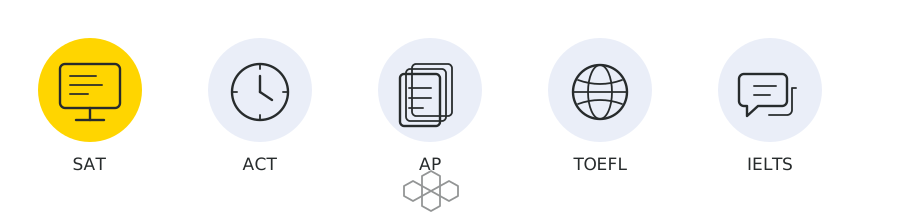
Full-length practice tests in the adaptive Digital SAT on-screen format, with two-module sections that adjust difficulty just like the real exam. Scoring is instant and includes a section-by-section skill breakdown.
Full-length ACT-format tests covering all four sections — English, Math, Reading, and Science — at real test timing. Instant scoring with a breakdown across each section.
AP exams test college-level knowledge in a specific subject. Each exam combines multiple-choice questions with free-response or essay sections, and a score of 3 or higher can earn college credit at many universities. Because the free-response formats differ significantly by subject — from lab-style questions in AP Chemistry to document-based essays in AP History — practicing under timed conditions is the most effective way to build the pacing instincts that separate a 3 from a 4 or 5. Full-length AP practice tests help you learn the format, manage time across sections, and identify which content areas need the most review before exam day.
Subjects currently covered:
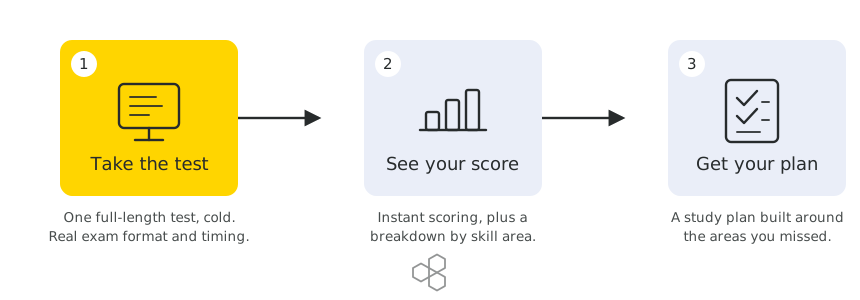
A true baseline only comes from a complete, uninterrupted first attempt with no lookups and no pauses. Resist the temptation to stop mid-section or check answers as you go — the point is to find out where you actually are, not where you could be with help. Treat your first practice test like the real exam day: sit for the full duration, use the same timing, and let the score reflect your current level honestly. If possible, take it in a quiet space with your phone out of reach, because the conditions affect the result. That honest starting point is what makes everything after it useful — it sets your target gap and tells you how much ground you need to cover before test day.
This is where the score actually moves. After you finish a practice test, go back through every question you got wrong and identify the specific reason you missed it: was it a content gap, a misread, a timing issue, or a careless error? Each category calls for a different fix, and lumping them together means you waste study time on the wrong things. Preppinbee's instant skill breakdown does some of this sorting for you, but spending time with individual questions is what turns a number into real understanding.
Once you know your weak areas, focus your study time there — not on topics you already score well on. A structured study strategy that front-loads your highest-impact gaps is far more efficient than working through random sets. Preppinbee's free study tools generate a personalized plan from your test results, so you always know what to work on next instead of guessing.
Take another full-length test every two to three weeks to see whether your targeted practice is moving the score. If a weak area has improved, shift your focus to the next one. If it hasn't, dig deeper into the specific question types you're still missing. Progress is not always linear — a score might plateau for a week before jumping — but regular retesting keeps your study plan honest and prevents you from drifting into comfortable practice on topics that no longer need attention. Over time, the pattern of your retest scores is the most reliable indicator of whether your study method is working or needs adjustment.